
Quantum optics & single-photon detection
Configure superconducting nanowire single-photon detection around photon counting, temporal correlations and weak-light reception.

What would you like to measure?
Twelve typical research directions across four fields: quantum information, quantum optics, optical communication & ranging, and imaging & precision measurement. Each direction weighs wavelength, efficiency, dark counts, timing jitter, count rate and channel count differently — use them as a starting point for configuration with our team.
Quantum information & communication
Quantum key distribution (QKD)
Decoy-state, MDI and TF fiber QKD experiments, where 1550 nm efficiency, dark counts and performance at high count rates matter most.
02Quantum networks & entanglement distribution
Multi-node entanglement distribution, quantum memory interfaces and repeater experiments that need synchronized channels, low jitter and long-term stability.
03Photonic quantum computing & boson sampling
In multiphoton interference and large linear-optical networks, channel count and overall efficiency set the multiphoton coincidence rate.
Quantum optics & fundamental physics
Quantum light-source characterization
HBT autocorrelation, HOM interference and state tomography of single-photon, entangled and squeezed sources, with detection and coincidence counting matched to timing and channel needs.
05Photon-number resolution & non-classical light
Squeezed states, Fock states and Gaussian boson sampling that need to distinguish photon numbers — evaluate the GAUSS photon-number-resolving series.
06Tests of fundamental physics
Loophole-free Bell tests, quantum nonlocality and quantum random-number experiments with very demanding efficiency and dark-count requirements.
Optical communication, sensing & ranging
Deep-space & free-space optical communication
Long-distance laser-communication receivers such as Earth–Moon and satellite–ground links, focused on large active area, multipixel counting and GHz-level maximum count rates.
08Single-photon lidar & 3D imaging
Long-range ranging, imaging through obscurants and non-line-of-sight imaging: jitter sets range precision, while active area and background rejection set reception.
09Fiber sensing & OTDR
Single-photon OTDR, distributed fiber sensing and link diagnostics, where low dark counts extend dynamic range and distance.
Imaging, spectroscopy & precision measurement
Single-photon imaging & weak-light detection
Photon-counting, scanning and time-resolved imaging at extremely low light levels, with multipixel or array detection for higher imaging speed.
11Solid-state quantum emitters
Lifetime, antibunching and spectral measurements of quantum dots, color centers and 2D-material emitters, often combined with a cryostat.
12Quantum metrology & longer wavelengths
Quantum-enhanced measurement, single-photon spectroscopy and weak-light detection up to 2 μm, with devices and filtering tailored to the target wavelength.
Connect the measurement chain
- 01Optical input
Free-space or single-/multimode fiber delivers the optical signal, matched in wavelength and mode field.
- 02SNSPD detection
A cryogenic superconducting nanowire absorbs single photons and produces a distinct electrical pulse.
- 03Bias and readout
Low-noise current bias and amplified readout deliver stable detection pulses.
- 04Timing and analysis
Time-to-digital conversion and coincidence counting reveal count rates, timing and correlations.
An indicative experimental workflow. Modules and compatibility are confirmed for each configuration.
Research and further reading
Capabilities & key specifications
Superconducting Nanowire Single Photon Detector System
Superconducting single-photon detection systemsPhotec was incubated in 2017 by an SNSPD research team from a Shanghai research institute, with fully in-house chip design, fabrication and system integration. Its SNSPD devices have repeatedly set records in detection efficiency and dark count rate, and the technology is patented in China.
- Maximum system detection efficiency
- 98%at 1550 nm; SDE >95%
- Lowest dark count rate
- 0.02 cpswith SDE >60% at 1550 nm
- Wavelength options
- 532–2000 nm532 / 850 / 1064 / 1310 / 1550 / 2000 nm
- Maximum count rate
- >GHz4-, 8- and 16-pixel arrays
Five core capabilities
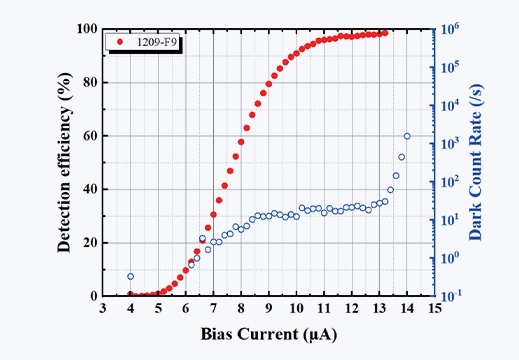
High detection efficiency
- Double-layer nanowire absorption enhancement
- SDE >95%, up to 98% at 1550 nm
- Wavelengths: 532, 850, 1064, 1310, 1550, 2000 nm
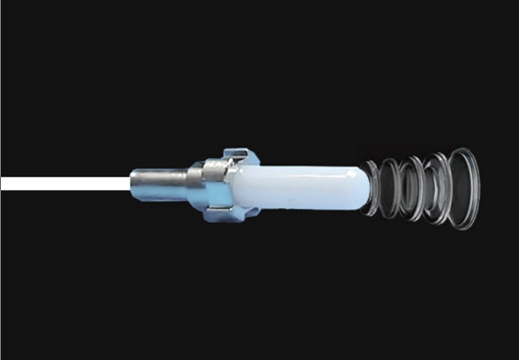
Low dark counts
- Cryogenic integrated filtering
- DCR down to 1 cps with SDE >90% at 1550 ±10 nm
- DCR as low as 0.02 cps with SDE >60% at 1550 nm
- Other wavelengths on request
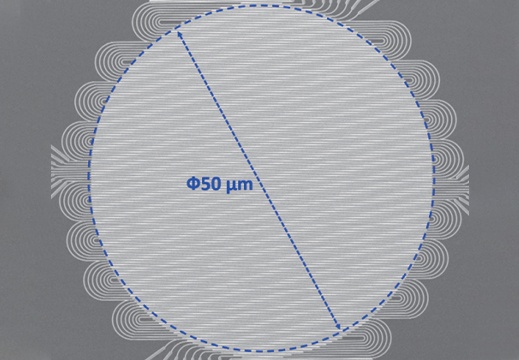
Large active area
- Wide field of view for free-space coupling
- 1550 / 1064 / 850 / 400 nm options
- 50 μm and 100 μm multimode fiber coupling
- Cryogenic filtering, DCR down to 100 cps
- Custom free-space coupling
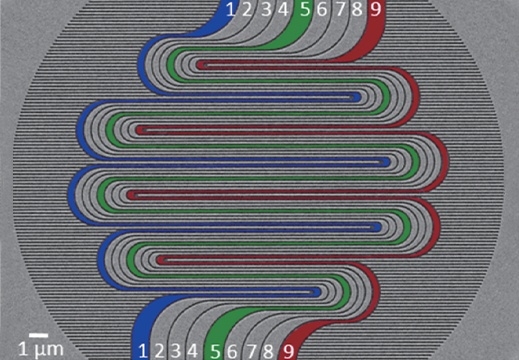
Multi-pixel devices
- 4-, 8- and 16-pixel SNSPD arrays
- Maximum count rate >GHz for high-speed optical communication

PMF-coupled high-efficiency SNSPD
- System detection efficiency >90% at 1550 nm
- Polarization-maintaining fiber coupled directly to the detector
- 1550-XP / 1550B-XP, FC/UPC or FC/APC and custom fiber length



Tell us about your experiment.
Share your sample, measurement goals and existing equipment so we can discuss a suitable configuration.
- Wavelength and bandwidth
- Channel count and coupling
- Priorities: efficiency, dark counts and count rate
- Timing electronics, synchronization and space